
- News
- City News
- chennai News
- What the hell? Over 500 die on Chennai roads every year
Trending
This story is from May 23, 2023
What the hell? Over 500 die on Chennai roads every year
More than 500 people die on Chennai roads every year, and most of the casualties are caused by traffic violations. As our understaffed traffic police lack in technology, many violators go scot-free, and all you can do is wonder...
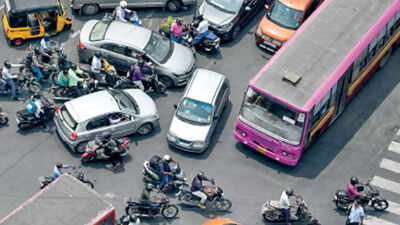
Sometime early last year, I was driving a rocket scientist around the city. We were approaching the Nandanam signal from the Saidapet side and were about to turn right to Chamiers Road.

The scientist friend joked: “You will have to accelerate at two metres per second at an angle of incidence of 30 degrees with a diminishing radius for 12 seconds if you want to avoid a collision with that bike coming from the right.
Can you attain escape velocity?” I slammed the brake. We laughed.
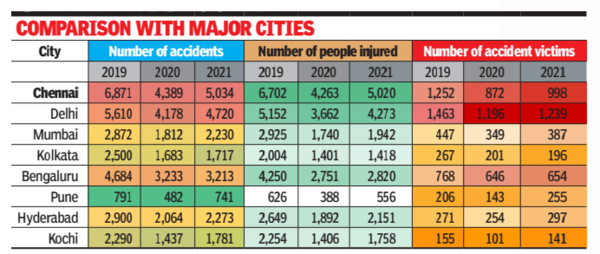
It’s no laughing matter that more than 500 people die in road accidents on Chennai roads every year (and we aren’t counting the deaths over road rage). In 2021, the city with a vehicular population of around 65 lakh, registered 5,034 accidents compared to 4,720 in Delhi, which has close to 80 lakh vehicles. While driving skills of motorists are presumably not too different across Indian cities, these numbers show something fundamentally wrong with the city’s traffic infrastructure, policing and motorists’ behaviour.
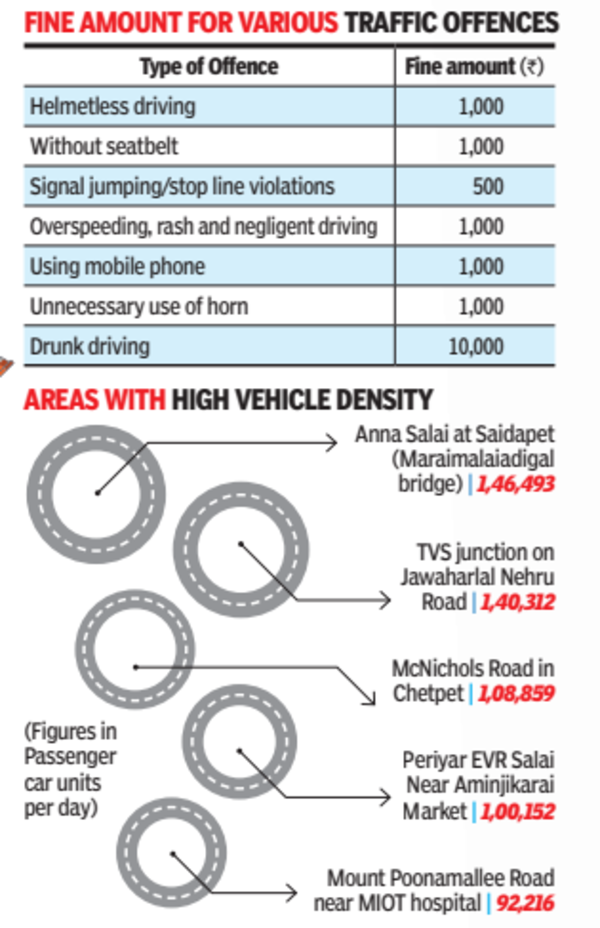
It’s not just speeding and drunk driving that kill thousands on our roads; driving on the wrong side of the road and jumping traffic signals cause a large number of accidents, and when motorists don’t wear a seat belt or helmet, the result is fatal. Signal jumping, if caught, carries the least penalty of ?500 (most of the other violations invite a fine of ?1,000; drunken driving gets ?10,000). But then, as retired Madras high court judge Justice S Chandru said, it’s the certainty of punishment more than the severity of punishment that will be a deterrent. In Chennai, the wayward motorist is often certain he can get away with murder on the road.
Chennai has about 3,500 traffic police personnel. While this is insufficient for a city of 65 lakh vehicles, technological upgrade, which can make up for inadequate human resources, has taken a backseat. The integrated traffic management system, which was proposed more than ten years ago for remote monitoring and imposition of road rulesin the city works in fits and starts. Senior road users tell us that incidents of traffic police taking bribes from violators have come down, but the corrupt elements have found e-transfer of bribes an efficient way to not leave the grease on the palm.
Often pedestrians and motorbike riders face the most serious consequences of violations (they are violators too), but road safety has to be a collective responsibility. We can have more rules and more stringent penalties for traffic violations, but the ultimate game-changer will be behavioural changes – in motorists and enforcers. Road safety awareness campaigns play a catalytic role, but the real drivers of thischange will be the person behind the steering wheel and the uniformed one at the traffic signal. The policeman should be trained and rewarded to ensure the motorist is disciplined.
A G Gardiner, in his famous essay ‘On the rule of the road’, talks about the policeman at the Piccadilly Circus being a “symbol not of tyranny, but of liberty”. TOI today starts a campaign against traffic violations, taking a leaf out of Gardiner’s book that says liberty, as in the case of roads, is not a personal affair, but a social contract.
Six most common traffic offences on Chennai roads
1. Wrong-side and pavement driving
In India, we drive on the left side of the road. But a visitor to Chennai wouldn’t believe that. Chennaiites drive on both sides of the road, and on pavements when they are there. The traffic police say they have booked 60,000 cases for this offence and collected more than ?1crore as fine in the first four months of 2023. Well, they should book a lot more people. Walk, ride or drive down any road in the city, and chances are you’ll have to dodge two-wheelers, autorickshaws, and sometimes even cars and vans whizzing past you in the opposite direction on your left. Protest and face abuse. The traffic diversions and road blocks for metro work have made things worse. Bikers would tell you that they have no intention of taking a kilometre-long detour just so that you can drive safely. And that is the crux of the problem. Attitude. For a couple of years, people had also got used to driving any which way on empty streets during the pandemic-induced lockdown. But the road accidents are rising and it’s time to drive right.
2. Signal jumping and stopline violations
If you think jumping signals and waiting well beyond the stopline at junctions will get to your destination faster, think again. For example, at least 350 vehicles can cross the Nandanam signal on Anna Salai (from Chamiers Road to T Nagar) in one 90-second cycle. But on an average, TOI found that only 120 vehicles could cross. Thirty vehicles had to wait another three minutes. This was because motorists going towards Saidapet had not stopped when their signal turned amber and they and they motorists who had just got the green signal were all dodging each other in the middle of the road. Adding to the chaos were motorists going north, who had crossed the stopline and were blocking the turn to T Nagar. This chaos plays out all day across the city. Every month, close to 45,000 motorists pay ?500 each as fine for these offences. This can be attributed to automatic number plate recognition (ANPR) cameras installed at twelve key traffic signals in the city. By next year, the police plan to cover 200 more road intersections.
3. Use of mobile phones while driving
P Velmurugan, an auto driver, is on the phone. As he weaves through traffic on Anna Salai, the conversation heats up and he loses his cool, and al-most rams a two-wheeler. Similar scenes play out all the time on city streets. People talk, and worse, watch stuff on their phones while driving, unmindful of the risk they pose to themselves and others. Every year, 30 people die in Chennai in road acci-dents caused by use of mobile phones. Under the New Motor Vehicles Act, the penalty for using a phone while driving is ?5,000. But police say technology makes their job harder. There was a time when constables used to stop cars and levy a fine if the driver was seen holding a phone. Now people use bluetooth earbuds while wearing a helmet. In cars, the hands-free system comes built-in. Many believe use of hands-free phone is safe. Road safety experts disagree.
4. Driving under influence of alcohol
Driving drunk is one of the ma-jor causes of fatal accidents in the city. Among 53 megacities in the country, more than 50 % of fatalities due to driving under the influence of drugs/alcohol were in Chennai — 236 of 462 deaths last year. The city police are on their toes, changing their check-points and manning even interior roads, but tipplers keep finding new escape routes. The penalty of ?10,000 is no deterrent. Many do not pay the fine, though an intimation is re-ceived on their mobile from the e-court sys-tem. The traffic po-lice have now warned violators that if the fine is not paid, war-rants will be obtained from courts to attach their movable property. Already, 340 such war-rants have been issued by courts. The traffic police also complain that there is little support from the state trans-port department. Though police book cases and rec-ommend suspension of driving licences, RTOs sel-dom follow through, allowing violators to go scot-free.
5. Overspeeding and negligent driving
The most ignored traffic violations are overspeeding and negligent driving. Traffic police say they have booked more than 23,000 cases of rash driving in 2022, but in most cases this is only an additional charge after a vehicle meets with an accident or a chain-snatcher or bike thief is caught. Hardly anyone is booked for overspeeding or rash driving other than bikers performing stunts on a few roads such as Kamarajar Salai. And these youngsters keep trying to hoodwink the police. Traffic police have installed six speed display boards at major junctions, but they should link these to their Automatic Number Plate Recognition (ANPR) cameras and start fining speed demons. This should not turn out like the advanced traffic management system installed at a cost of ?8.6crore on East Coast Road. No one knows if it works. And what about people who refuse to maintain lane discipline and end up holding up traffic?
6. Not wearing helmets and seat belts
Helmet-less two-wheeler riders arguing with police personnel who fine them is a common sight across Chennai. In 2022, more than 100 bikers riding without helmets died in road accidents in Chennai. Nearly half of them were pillion riders. Most of the accidents happened when people drove to a market or an ATM near home and thought they didn’t need a helmet for such a short distance. “Despite knowing the risks, bikers presume that they won’t meet with an accident, and willfully ignore the helmet rule. A few others argue helmets obstruct their vision and hearing. This is why people should wear helmets from the day they start learning to ride bikes,” says Prasanna, a retired sub-inspector of police. Police say most riders wear helmets, but not the pillion, and hardly ever the children perched precariously between or in front of their parents. As for wearing seatbelts in cars, the level is as low as 30% even in areas such as Anna Nagar, Velachery and Royapuram where automatic number plate recognition (ANPR) cameras have been installed to detect such violations. As for rear seat passengers, hardly anyone belts in. Experts say more awareness needs to be created among the public about how air bags work only when passengers wear seatbelts.
(With inputs from Vivek Narayanan, Ram Sundaram, Ayyappan V, Sindhu Kannan, Venkadesan S and A Selvaraj)
End of Article
FOLLOW US ON SOCIAL MEDIA










Photostories

Hot Picks
TOP TRENDING
Popular Categories
Hot on the Web
Top Trends
Tirupati LadduIsrael Hezbollah WarRahul GandhiShan MasoodBryonna Burrows Net WorthIndian Team Fastest Test FiftyWTC Points TableUGC NET Result 2024GovindaWomen T20 World Cup Points TableWomen T20 World Cup ScheduleEarth Two MoonsIPL Player RegulationsAsteroid 2024 PT5DiddyTop Management Colleges of IndiaLive Cricket Score
Trending Topics
GovindaNavratri Colours 2024Deadpool and Wolverine OTT ReleaseNavratri WishesGandhi Jayanti WishesDevara CollectionGOAT OTT ReleaseGandhi Jayanti 2024Rajinikanth Health UpdateNavratri HistoryDevaraGovinda NewsDevara Movie ReviewHealthy RaitasSwatantrya Veer SavarkarColdplay India tour 2025Upcoming Smartphones In OctoberAmazon SaleSony Bravia 55 inch 4k Ultra HD TVWordle Answer
Living and entertainment
Latest News
Gunther finally accepts Sami Zayn’s challenge for the World Championship on WWE RAWMan orders iPhone with CoD option on Flipkart, kills delivery agentWhen Rishi Kapoor slammed Deepika Padukone and Sonam Kapoor for making immature remarks about Ranbir KapoorShark Tank India 4: Sharks begin shooting for the new season; Sahiba Bali and Ashish Solanki join as new hostsFestivals in October 2024: From Navratri, Dussehra to Diwali, check complete list hereShannon Sharpe compares Patrick Mahomes' current situation to Tom Brady's past as Chiefs adjust to roster changesUCEED 2025 registration begins at uceed.iitb.ac.in, direct link to apply here: Check detailed admission scheduleReport: By 2035, EVs Expected to Use 6% to 8.7% of India's ElectricityMahima Chaudhry reveals she begged Ajay Devgn and Prakash Jha to keep her near-fatal car accident secret: 'I feared industry boycott'Vijay's 'GOAT' gets an OTT release; official date announced!Haryana polls: Brick thrown at car in Dushyant Chautala's convoy in Jind; case filedMumbai vs Rest Of India: Irani Cup tie offers chance for hopefuls and rejects to impress selectorsCSK to connect with MS Dhoni in 'coming week', undecided on using IPL uncapped player ruleHow to use charcoal powder to whiten teethA night-long musical extravaganza, ‘Raat Pohalo Sharodo Praate’ to usher Devipokkho with unforgettable melodiesOlivia Culpo and Christian McCaffrey buy George Clooney's mansion for $14.5 millionElon Musk lost legal battle over unpaid severance to former Twitter employeeStree 2 Box Office Collection day 47: Shraddha Kapoor starrer falls below Rs 1 crore for the first time
Copyright © 2024 Bennett, Coleman & Co. Ltd. All rights reserved. For reprint rights: Times Syndication Service